On this page
Learn Pathfinding Algorithms Interactively
A visual, hands-on textbook for understanding how computers navigate through space. Draw maps, run algorithms, and watch every decision happen in real time.
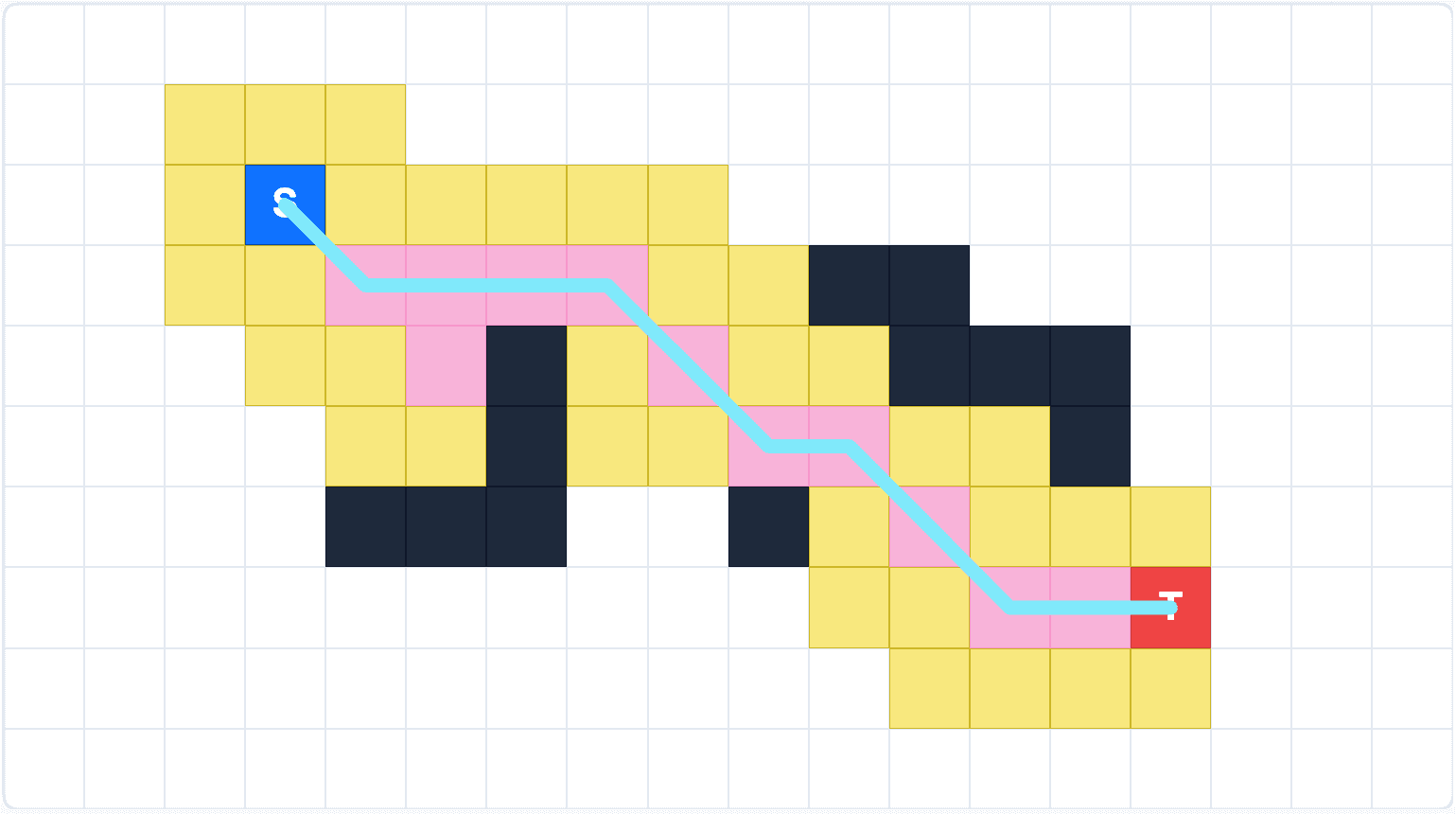
What you'll find here
Everything you need to truly understand pathfinding — not just memorise it.
Interactive Grids
Click and drag to draw walls, place terrain, and reposition start and goal nodes. Your map, your rules.
Step-by-Step Traces
Scrub a slider through every decision the algorithm makes — see exactly which nodes are explored and why.
Algorithm Comparison
Understand how A*, Dijkstra, and BFS differ in their search strategies on the same map.
Algorithms
Start with A*, then explore the broader family of heuristic-search algorithms.
Depth-First Search
Dives deep before backtracking. Not optimal, but illustrates how graph traversal fundamentally works.
Breadth-First Search
The simplest pathfinder. Explores layer by layer and finds the shortest path on unweighted graphs.
Dijkstra's
A* without a heuristic. Explores in all directions equally, guaranteed to find the optimal path on weighted graphs.
A* Algorithm
The gold standard for single-source pathfinding. Combines actual cost and a heuristic to find the shortest path efficiently.
Heuristics
Explore state-of-the-art heuristics for efficient pathfinding.
Compressed Path Database (CPD)
A precomputed database of optimal paths between key locations. Reduces search time by providing informed estimates for the remaining distance.
Differential Heuristic (DH)
Select a few landmark nodes and precompute distances to all other nodes. Heuristic estimates are derived from these landmark distances.
Fast Map Heuristic (FM)
A fast approximation of the optimal path distance. Provides a good balance between accuracy and computation time.
How it works
Choose an algorithm
Pick from our growing library of pathfinding algorithms, each with its own tutorial page.
Draw your map
Place walls, terrain, start, and goal on the interactive grid. Change it at any time.
Step through the trace
Hit Run, then drag the slider or press Play to watch every decision unfold step by step.